Chapter 2 · Section 1
DataFrames and the First Look
§1 — DataFrames and the First Look
Identify what a row represents, load a table, and inspect its structure before analysing it.
Cross-sectional Data versus Time Series
First ask: what does one row represent?
| Cross-sectional data | Time-series data | |
|---|---|---|
| Compare | Different entities in the same period | The same entity or measure over time |
| Example | One row per customer this month | One row per day of a store’s sales |
| Row order | Usually no natural time sequence | Chronological order matters |
| Missing values | Consider comparable entities and the variable’s distribution | Respect time and what was known then |
| Train/test split | Random split can suit independent entities | For forecasting: earlier train, later test |
Our order-line table contains transactions. Aggregating sales by day creates a time series.
A Column Is a Series
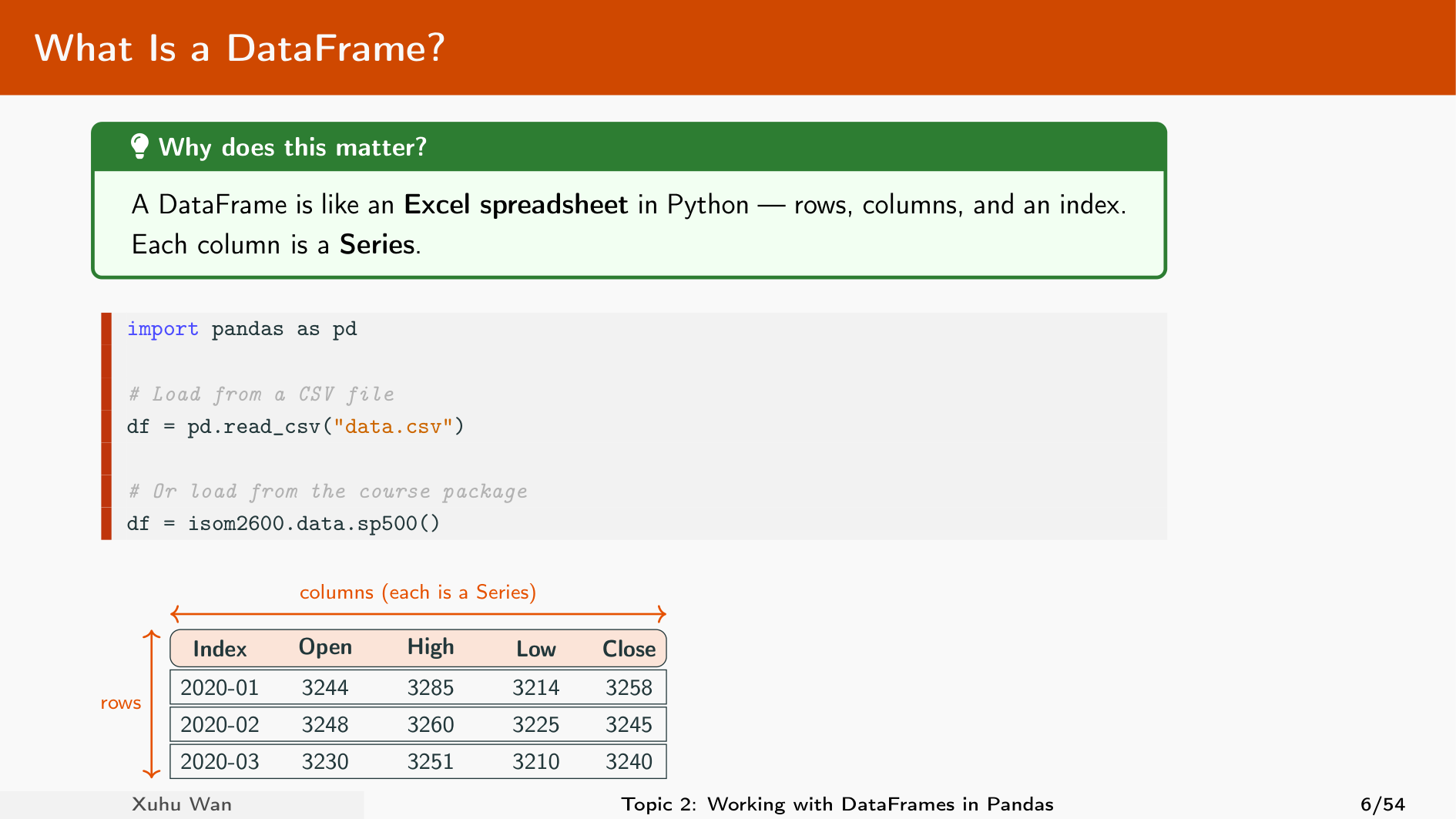
A Series is one labelled variable. A DataFrame places related Series in columns and gives them a shared row index.
Rows, Columns, and the Index
Read across a row for one observation. Read down a column for one variable. Index labels identify rows; numerical positions count from 0.
Create a Small DataFrame
pd.DataFrame({...}) uses dictionary keys as column names and lists as column values. Supply an index= when meaningful row labels are available.
Change one price, then run the box again. Check which cell changes.
Load a CSV File
A CSV stores a table as text separated by commas. pd.read_csv() returns a DataFrame. The first line normally supplies column names.
DataFrame Attributes
Attributes describe the table and have no parentheses. .shape is (rows, columns); .columns and .index contain labels; .dtypes gives one data type per column.
DataFrame Methods
Methods perform a task and use parentheses. .head(2) returns the first two rows. .tail(2) returns the last two. .info() prints a structural summary.
.info() prints its report; avoid wrapping it in print(...), which would also print its return value, None.
Column Types and Business Meaning
Quantity is numerical, Store is categorical, and Date initially contains text. A number-like code may still be an identifier. Data type and business meaning both matter.
In-Class Practice: Inspect an Order Table
Print the row count, return the final two records, and name the column containing unit prices. Explain whether the index identifies stores or orders.
Hint: .shape[0], .tail(2), and .columns. Expected: four rows, last labels C and D, prices in Price.
Prof. Xuhu Wan · HKUST ISOM · Introduction to Business Analytics